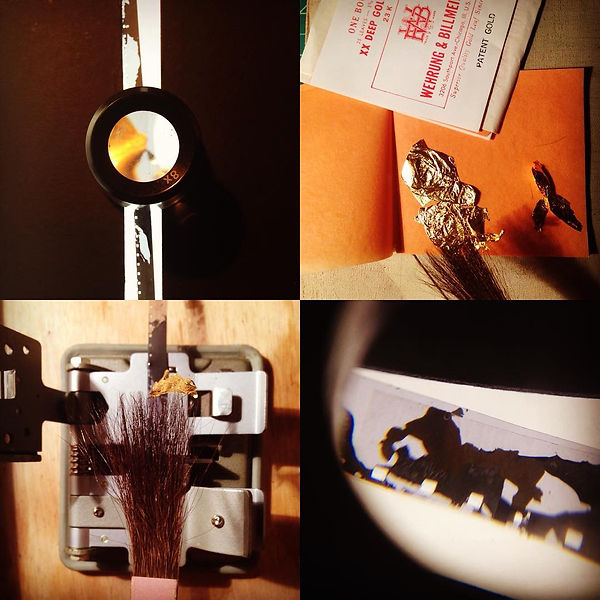
Gold Leafing Super 8
I know what you've been asking yourself: How do I gold-leaf that Super 8mm footage my Granny shot in 1964 of my Granddad eating an egg sandwich on Blackpool beach?
The idea of gold-leafing Super 8 first came to me in conversation with a friend of mine who collects and restores Louis XVI era French furniture, it was from him that I learnt the basic technique involved in the ancient craft of gilding and borrowed the tools to start. According to my discoveries so far, there are three effective methods of gilding Super 8mm film and I will expand on these methods below:
Note: All these methods involve leafing the emulsion side of the film (rather than the gloss side) for more permanent results (but like every decision in art - that's optional).
METHOD (1)
'The Tape Method', here one simply wets the surface one wishes to leaf, cuts & applies the leaf, then places splicing tape on top to secure it in place. The advantage of this method is that it attaches the gold-leaf to the film securely, the disadvantage is that it tends to 'bubble up' in a way that interferes with the image clarity of the projected leaf.
METHOD (2)
'The Clear Leader Overlay Splice Method', here one uses clear leader (this can be made by soaking none-clear film in bleach/water ratio 1:10 for 5mins) and film cement to secure the gold leaf. As with method 1 you begin by adding the leaf to the wetted emulsion side of the section of film you want to leaf, but then you add a thin layer of film cement follow by the pre-cut leader. It helps to have a Super 8 Splicer for this method to clamp down on to the film and leave for 30mins to dry under pressure. The advantage of this method is a very protected gold leaf with very little interference 'bubble' from cement/tape, the disadvantage is that you are basically doubling the thickness of the film, this can cause it to snag - especially if projecting as part of a 'looped' installation.


METHOD (3)
'The Pure Cement Method' this is my favourite, here instead of water one begins by applying a thin layer of film cement to the surface before applying the pre-cut gold-leaf (use an old watercolour brush not an expensive gilding brush on the cement!). Again it helps to have a Super 8 splicer for this method to ensure a flat surface and consistent drying, and place a small sheet of baking-paper on top before closing the splicer as this helps prevent the gold-leaf/cement from sticking to the splicer whilst drying. The advantage to this method is that it gives a pure unimpeded projection of the gold-leaf - its subtle folds and depth of colour. The disadvantage is that the projector will eventually scratch and wear down the gold-leaf especially if looping - though I personally consider this part of the temporal nature of any Super8mm installation and therefore not a problem.
On a final cautionary note: gold-leafed Super 8mm projects a deep marine green, this is unlike the fake 'gold-leaf effect paint' that isn't translucent at all and so just projects black speckles, so if you want genuine green you must go for genuine gold!